Why Do I Keep Overthinking?

You think you've reached a decision.
Then you begin doubting it.
So you think about it again.
You replay the conversation.
Imagine a different outcome.
Consider one more possibility.
Hours later, nothing has really changed except that you feel more exhausted than when you began.
If this feels familiar, you're not alone.
One of the reasons people keep overthinking consequential decisions is that the mind quietly mistakes certainty for understanding.
It believes one more thought might finally remove the uncertainty.
For many important decisions, it never can.
It Is Rarely About Thinking More
People often assume overthinking means they are confused.
Or indecisive.
Or lacking confidence.
More often, the opposite is true.
The decisions we overthink are usually the ones that matter most.
They carry consequences.
They affect people we care about.
They shape futures we cannot fully predict.
Overthinking is often what happens when we ask our thoughts to produce certainty instead of understanding.
When Thinking Is Asked to Do the Impossible
Thinking is remarkably good at helping us understand reality.
It allows us to recognise patterns, consider consequences and make sense of complexity.
The difficulty begins when we quietly ask it to do something else.
To guarantee the future.
To remove every uncertainty.
To protect us from every possible regret.
No amount of thinking can fully achieve those things.
Yet the mind continues searching because it believes certainty is still waiting to be found.
Why the Thoughts Keep Returning
Every new thought feels as though it might finally settle everything.
So we keep thinking.
One more conversation.
One more perspective.
One more day.
The harder we search for complete certainty, the further it often seems to move away.
Not because we are failing to think clearly.
Because certainty is asking our thoughts to do work they were never designed to do.
Understanding Is Different From Certainty
One of the quiet discoveries within consequential decisions is that understanding and certainty are not the same thing.
Understanding allows us to recognise reality.
Certainty asks us to know what has not yet happened.
Consequential decisions rarely offer that.
Recognising the difference quietly changes the relationship we begin having with our own thoughts.
When Thinking Becomes Quieter
The uncertainty may remain.
The decision may still require courage.
What changes is the work we ask our thinking to do.
It no longer has to produce certainty.
It simply returns to helping us understand reality.
Related Insights
If this experience feels familiar, these Insights explore the deeper realities that often sit beneath overthinking.
What Pressure Makes Harder to Decide — how pressure quietly changes the way we think and experience consequential decisions.
The Waiting Room — why periods between one chapter ending and another often feel like being stuck.
Hold Your Poise — how remaining internally steady allows understanding to deepen while uncertainty is still present.
Continue Exploring
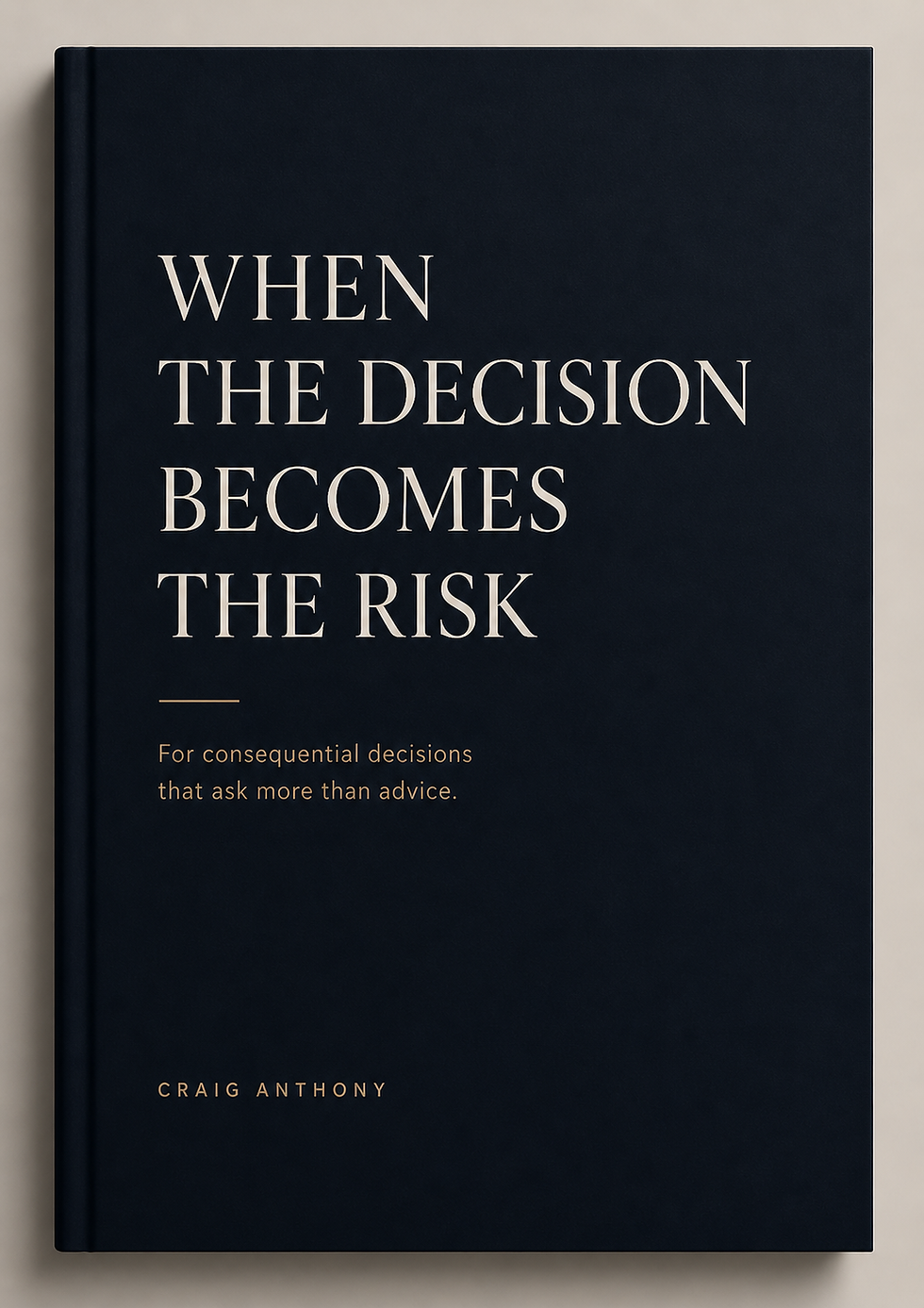
The ideas explored in this Insight form part of the broader work behind the book.
Or


Comments