Momentum Begins to Decide

The Illusion of Standing Still
Most consequential decisions do not remain where we leave them.
We often imagine that by postponing a decision, we are preserving our options. It can feel as though nothing has changed simply because no formal choice has been made.
The decision appears to be waiting for us, untouched, until we are ready to return to it.
But life rarely stands still.
We may stop examining a decision.
Reality does not.

While We Wait
While we hesitate, reality continues moving.
Relationships evolve.
Businesses change.
Health shifts.
Markets move.
Children grow older.
Trust strengthens or weakens.
Opportunities emerge, then quietly disappear.
Other people make decisions of their own.
Circumstances that once seemed stable continue changing without asking for our permission.
The decision has not remained suspended.
It has continued unfolding.
This is one of the least recognised realities of consequential decisions. We often believe we are delaying the decision itself, when in fact we are allowing momentum to gather around the direction we are already travelling.
Without intending to, we begin living inside a decision we have not consciously made.
Momentum Builds Quietly
Momentum is rarely dramatic.
It builds quietly.
A difficult conversation is postponed because the timing never seems right.
Another month passes.
Then another.
The relationship gradually adapts to a pattern neither person consciously chose.
A business owner delays addressing an issue that has become increasingly apparent.
The problem does not remain where it was first discovered.
It grows.
People adjust around it.
Expectations change.
The cost changes, even though the decision does not.
Someone remains in a role they already know has reached its natural conclusion.
Each day feels manageable in isolation, yet over time the weight accumulates.
Confidence begins to diminish.
Possibility narrows.
What once felt like a freely made choice slowly becomes the path of least resistance.
Nothing significant appears to happen on any particular day.
Yet everything changes.
Momentum rarely announces itself. More often, it is recognised only in hindsight, when we realise the circumstances before us are no longer the circumstances we believed we still had.
When the Landscape Changes
This is why waiting quietly reshapes the very decision we believe we are postponing.
The options available today may not exist six months from now.
The conversation that could once have been held openly may later occur under pressure.
The business that could have been sold from a position of strength may eventually be sold from necessity.
The relationship that might once have been examined with curiosity may instead reach a point where understanding has given way to exhaustion.
Time does more than increase urgency.
It changes the landscape.
Many people reach a moment when they finally decide they are ready to act, only to discover they are no longer deciding between the same possibilities they once had.
Reality has continued moving while understanding remained behind.
Perhaps this is why consequential decisions become so difficult.
We are not only trying to decide what to do next.
We are also trying to understand how much has already changed while our attention was fixed on preserving certainty.
The Momentum We Adapt To
Sometimes the greatest shift has not occurred in the situation itself.
It has occurred within us.
We become accustomed to carrying what once felt temporary.
We adapt to uncertainty.
We reorganise our lives around unanswered questions until the unresolved begins to feel familiar.
What originally demanded examination gradually becomes normal.
Momentum has a quiet way of making the existing direction feel inevitable.
Patience Is Not Postponement
Recognising this is not an argument for rushing important decisions.
Some decisions require patience.
Some require time for emotion to settle, for information to emerge, or for understanding to deepen.
But patience and postponement are not the same thing.
Patience remains engaged with reality.
Postponement quietly turns away from it.
There comes a point in many consequential decisions where the greatest influence is no longer the decision itself, but the momentum created by leaving it unresolved.
The question is no longer whether a decision has been made.
It is whether momentum has already begun shaping the future before we have consciously chosen it.
Continue Exploring
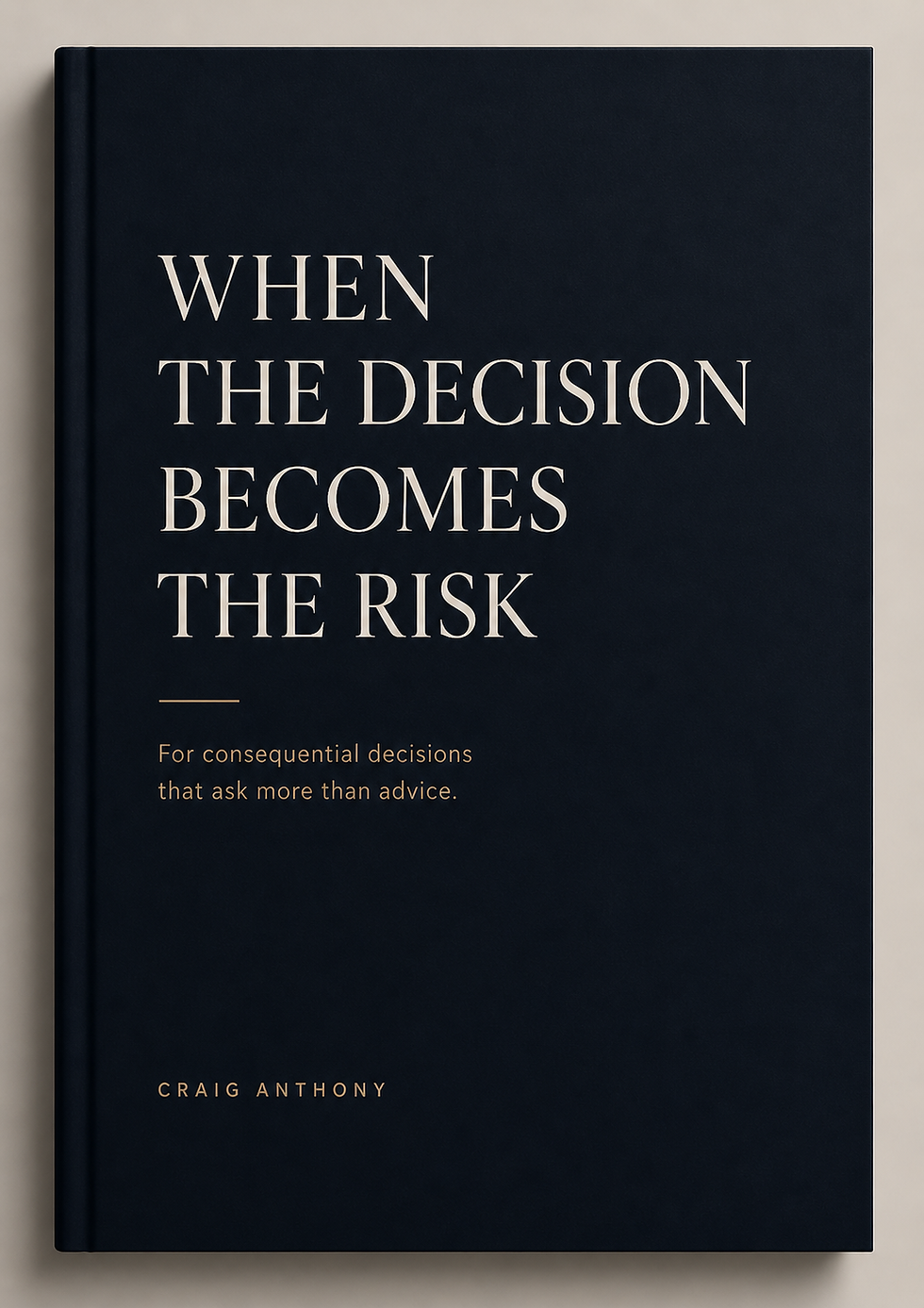
The ideas explored in this Insight form part of the broader work behind the book.
Or


Comments